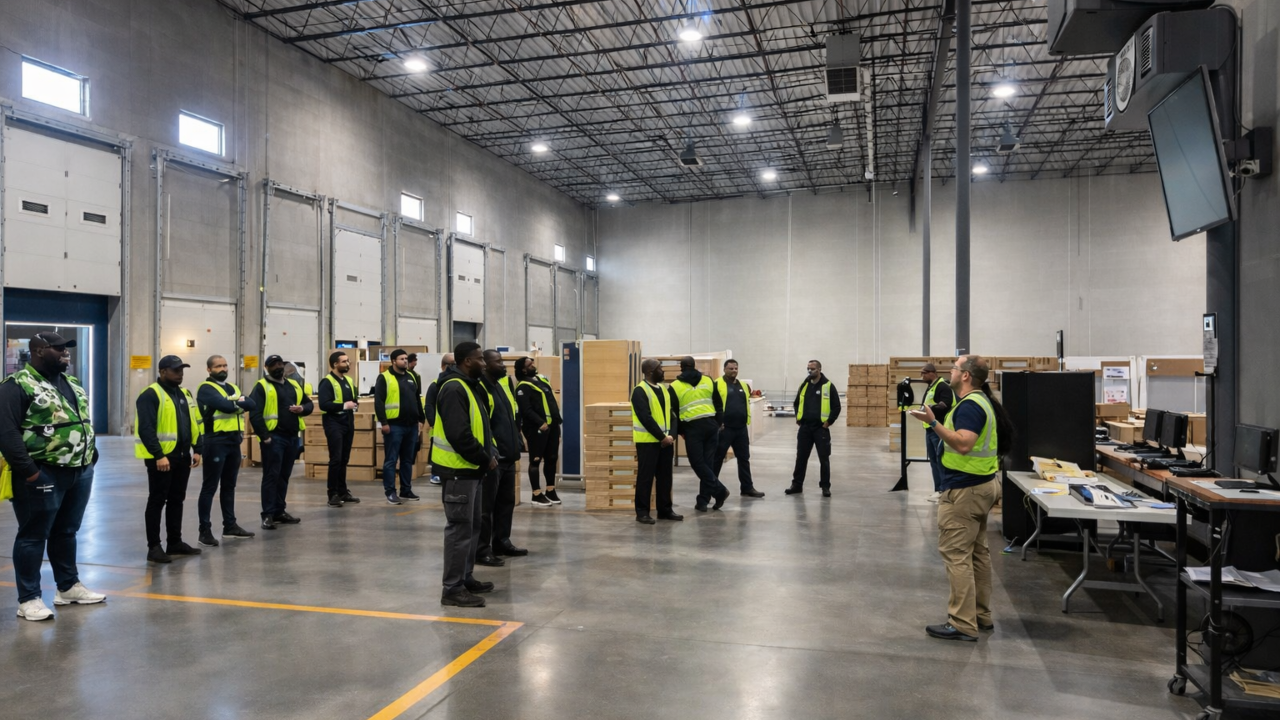
The Giant Company will shut down five automated grocery fulfillment centers in Pennsylvania by April 2026, closing another facility in Virginia through parent company Ahold Delhaize USA and taking a $50 million non-cash impairment charge. The move signals a sharp turn away from costly, centralized warehouses toward a “store-first” model that leans on existing supermarkets and third-party delivery platforms.
From Showcase Facilities to Costly Assets
Just a few years ago, facilities like Giant’s Philadelphia operation were promoted as the future of online grocery. Opened in November 2021, the 124,000-square-foot site used advanced robotics from Swisslog and AutoStore to handle as many as 15,000 orders a week across 22,000 products. Now the center is slated to close permanently, with 128 employees receiving termination notices effective February 13, 2026.
Four additional Pennsylvania facilities in Willow Grove, Coopersburg, North Coventry, and Lancaster will also be shut down, along with an Ahold Delhaize USA site in Virginia. The Lancaster operation, where 81 people work, is scheduled to close by late April 2026. Coopersburg employs more than 100 workers, who are being offered alternative roles. As of late December 2025, formal WARN notices had not been filed for every location, but hundreds of jobs across the network are affected.
The company describes the shift as a response to changing online grocery economics, as capital-intensive, highly automated hubs struggle to achieve sustainable margins.
Why Stores Are Replacing Central Hubs
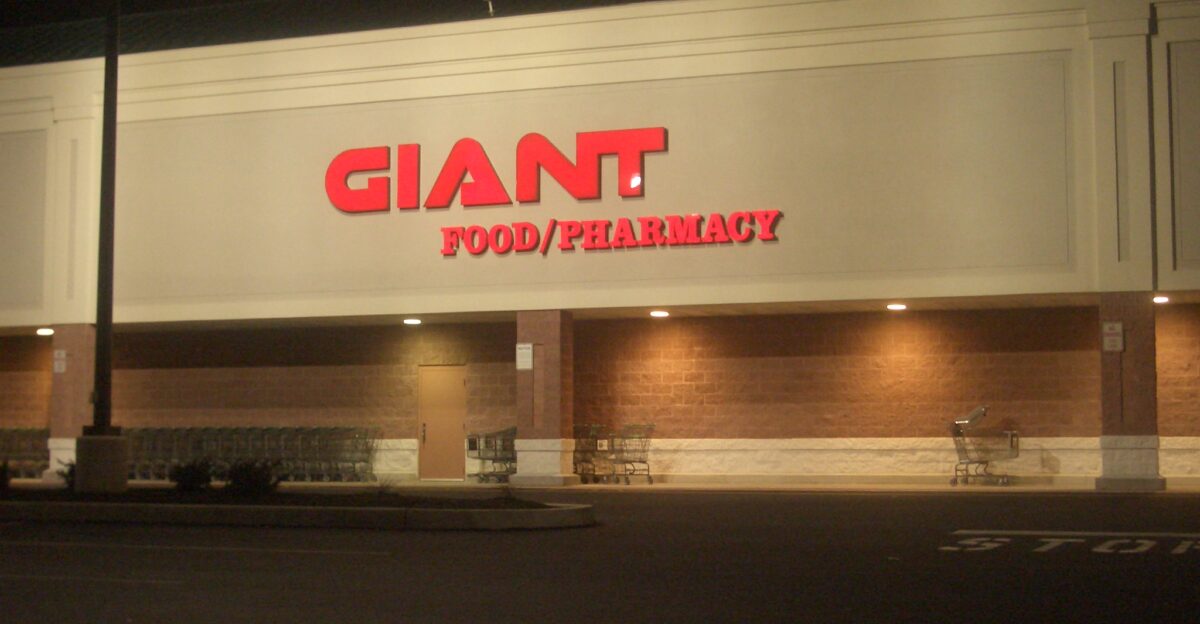
Giant is moving toward order picking inside its supermarkets, combined with delivery handled by partners such as Instacart and DoorDash. Instead of relying on a small number of large warehouses, the new setup uses stores as local nodes, placing inventory closer to customers and shortening delivery routes.
Under this model, customers can receive orders in as little as 30 minutes, with one-hour windows now standard. Shoppers gain access to the full in-store assortment and pay in-store prices, rather than facing narrower online selections or separate pricing structures. Orders can be adjusted two to three hours before delivery, tighter than the previous four- to six-hour change window.
Operationally, the approach converts fixed infrastructure and labor costs into variable expenses that rise and fall with order volume. Store employees can shift between in-aisle picking for online orders and traditional retail tasks depending on demand. This flexibility is particularly valuable during peak periods, when centralized facilities can become bottlenecks while stores can tap broader staffing pools.
Centralized hubs, by contrast, require large upfront investments in buildings and automation, and they carry high fixed costs regardless of order volume. Longer delivery distances can inflate last-mile expenses, while rigid capacity is poorly suited to frequent swings in demand and the complexities of fresh, frozen, and ambient grocery items.
Industry Signals: From Kroger’s Losses to Walmart’s Gains
Giant’s decision aligns with a broader industry recalibration. In November 2025, Kroger announced the closure of three automated fulfillment centers built with Ocado Group and canceled plans for another facility in Charlotte. The company reported $2.6 billion in impairment charges and agreed to pay Ocado $350 million to unwind future commitments, after shuttering sites in Wisconsin, Maryland, and Florida within roughly three years of opening.
At the same time, major rivals that emphasized store-based fulfillment earlier are now reporting stronger financial results. Walmart reached e-commerce profitability in early 2025 and generated an estimated $69.4 billion in online grocery sales that year, capturing about 31.6% of the U.S. market with projected 21% annual growth. Amazon leans on Whole Foods locations and other stores, while Target has long used a store-first approach.
Ahold Delhaize USA itself reported that e-commerce became profitable on a fully allocated basis in the first half of 2025. Chief financial officer Jolanda Poots-Bijl cited asset-light models such as pickup, expanded fulfillment capacity, and targeted automation as key factors. In the third quarter of 2025, the company’s U.S. operations recorded 15.4% online sales growth while maintaining an underlying operating margin of 4.6%.
Rising Demand, Pressure on Profits
Online grocery demand continues to climb. U.S. e-grocery sales reached $12.5 billion in September 2025, up 31% from a year earlier and a new monthly record. Nearly 19% of household grocery spending moved online, the highest share since early in the pandemic, and monthly active users across delivery, pickup, and ship-to-home methods rose almost 13% year over year.
Yet most retailers still struggle to make the economics work: profitability remains the top concern for 93% of grocers. One growing challenge for regional chains is cross-shopping. In June 2025, one in four households that ordered from supermarkets also placed online orders with Walmart, a rate that has increased every June since 2020. Analysts view this pattern as a sign of gradual market share erosion for smaller players.
For Giant, the stakes are significant. The company operates 174 stores in Pennsylvania and 193 in total across Pennsylvania, Maryland, Virginia, and West Virginia, along with 133 pharmacies and 107 fuel stations. It holds roughly 15.94% market share in the Philadelphia area. Its fulfillment strategy is central to maintaining that position against national competitors with larger footprints and deeper capital resources.
Giant and Ahold Delhaize are also investing in technology to support an integrated approach. In November 2025, Ahold Delhaize USA completed rollout of a proprietary cloud-based omnichannel platform across its five U.S. brands, serving more than 26 million weekly customers and powering thousands of daily online orders. The system is designed to improve website speed, personalize promotions, unify ordering, and provide real-time inventory visibility.
Looking Ahead: Store-First Models and Worker Impact
Ahold Delhaize USA says it will offer displaced fulfillment-center workers comparable positions in its supermarket banners or in other parts of the organization. In a 2024 transition at Giant’s Camp Hill facility, more than 80% of staff reportedly accepted alternative roles. Still, commuting distances, scheduling, and the shift from specialized warehouse work to in-store picking mean some employees may not find the options viable.
At the same time, stores are becoming the focal point for new forms of automation. Large chains are testing micro-fulfillment systems and pick-assist technologies inside or adjacent to supermarkets, blending robotics for high-turnover products with manual picking for slower-moving items. Amazon is piloting such tools in a Whole Foods location in Pennsylvania, while Kroger plans to trial capital-light, store-based automation in busy markets.
Ahold Delhaize is also redirecting investment from unprofitable e-commerce hubs to its core supply chain, including an $860 million distribution center in Burlington, North Carolina, to replenish physical stores. Industry forecasts suggest online grocery sales could reach $388 billion by 2027 and approach 25% of total market penetration. Analysts increasingly expect store-first and hybrid approaches, supported by third-party delivery platforms and selective automation, to dominate as retailers seek models that can handle volatile demand while delivering sustainable returns.
Sources:
“Giant Food and The Giant Company to shutter centralized e-commerce fulfillment centers.” Grocery Dive, December 2025.
“Ahold Delhaize reports strong Q3 performance; 2025 outlook reconfirmed.” Ahold Delhaize Corporate Newsroom, November 2025.
“Kroger cancels plans for additional automated fulfillment center, closing spoke facility.” Supply Chain Dive, December 2025.
“September 2025 eGrocery Sales Jump 31% Versus Year Ago to $12.5 Billion.” Brick Meets Click, October 2025.
“Giant Food and The Giant Company to shutter centralized e-commerce fulfillment centers.” Yahoo Finance/Reuters, December 2025.