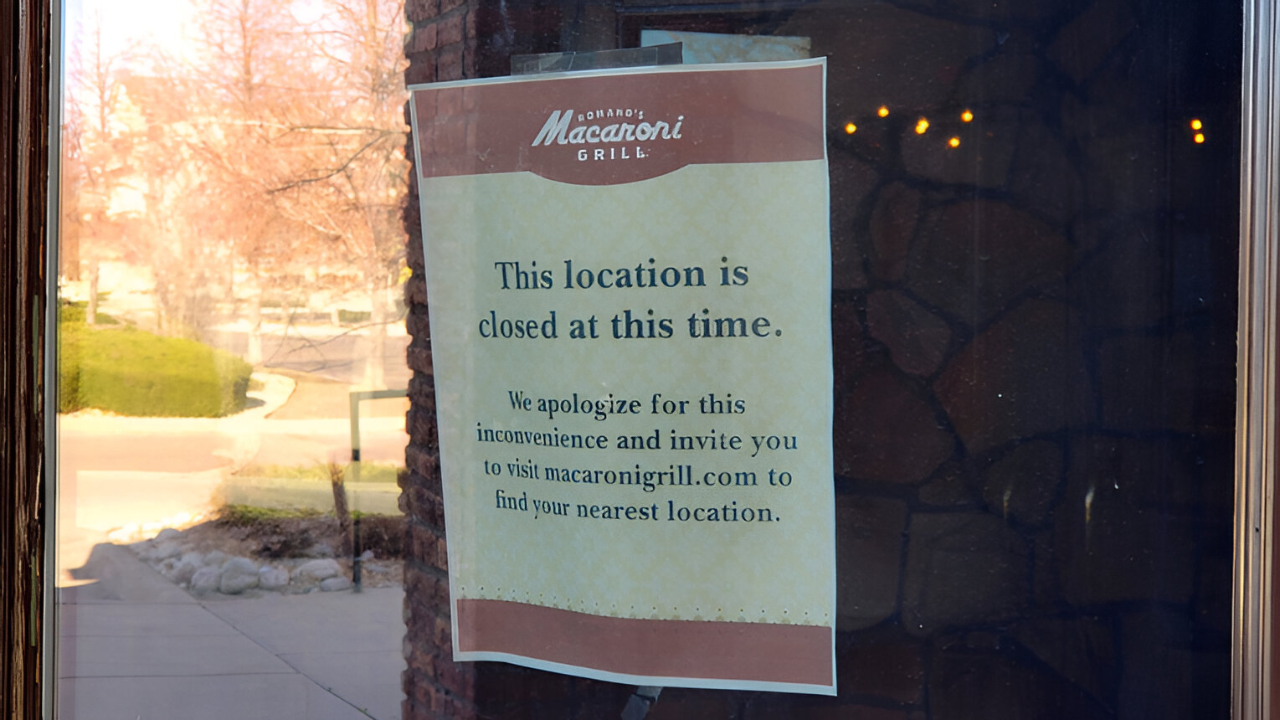
Romano’s Macaroni Grill, once a fixture in American suburbs with over 200 locations nationwide, has virtually disappeared from the landscape. Only nine restaurants remain operational in early 2026, marking the near-total collapse of a brand that spent three decades competing directly with industry giants like Olive Garden. The contraction represents more than corporate restructuring—it’s a case study in how expansion ambitions, mounting debt, and failure to adapt can erase even established names from the dining map.
The Magnitude of Retreat
The chain’s footprint has contracted by roughly 90% over the past decade. Founded in 1988 in Texas by restaurateur Philip Romano, the brand rose during the casual-dining boom by offering theatrical tableside pasta preparation, wood-fired ovens, and family-friendly Italian-American fare. By the mid-2000s, it operated more than 200 locations and positioned itself as a serious national competitor in the Italian segment.
Warning signs emerged between 2009 and 2014 when dozens of underperforming locations closed as costs climbed and customer traffic softened. A Chapter 11 bankruptcy filing followed in 2017. While restructuring provided temporary relief, deeper problems—weak unit economics and declining brand relevance—remained unresolved. By 2021, the footprint had shrunk to 41 restaurants. Sales declines accelerated through 2024 and 2025, leaving fewer than ten locations by early 2026.
An Industry Sorting Winners from Losers
Romano’s collapse unfolds against a counterintuitive backdrop: U.S. restaurant closures hit a seven-year low in 2025. Just 886 closures occurred in April 2025—an 82% drop from January 2018 levels, according to Datassential. The restaurant sector overall remains stable. What’s happening is selective culling, with weak chains disappearing while stronger brands consolidate customer demand.
Romano’s is far from alone. Starbucks closed approximately 500 North American locations and eliminated 900 corporate roles as part of a $1 billion restructuring. Wendy’s shuttered hundreds of outlets through its “Project Fresh” turnaround. Denny’s, Papa John’s, and Jack in the Box also trimmed their systems. Across formats, underperforming concepts are being pruned while successful operators capture market share.
Casual dining as a category showed unexpected strength in 2025, with chains like Chili’s and Olive Garden posting robust growth by emphasizing value bundles and promotional offers. The difference? Olive Garden leveraged unlimited soup, salad, and breadsticks to reinforce perceived value, while Romano’s competed mainly on price without comparable perceived benefits. Mid-priced concepts that failed to communicate clear value propositions got squeezed between low-cost quick service and premium dining experiences.
Romano’s passed through multiple ownership groups as financial stress mounted—from Brinker International to Golden Gate Capital, Ignite Restaurant Group, Redrock Partners, and finally RMG Acquisition Company in 2023. Each transition promised stabilization through capital injections and operational changes. None reversed the trajectory. Once unit-level profitability turned negative across much of the system, reopening stores required more investment than projected returns could justify.
The Workforce Impact
Behind each closure were servers, cooks, and managers abruptly cut loose. Many employees had spent years—or decades—at their local Romano’s. Several shutdowns occurred without extended notice, forcing workers to scramble for new positions. While some found work in a tight labor market, others lost seniority, benefits, and stable schedules.
Romano’s implosion reflects broader volatility facing restaurant workers nationwide. As chains shrink or restructure, frontline employees bear immediate risk. Sudden closures create income gaps that ripple through families and local economies. Even at Starbucks, which offered severance packages during its restructuring, approximately 900 corporate employees lost positions, and baristas faced relocation or separation. The pattern underscores how vulnerable restaurant labor becomes when large systems retreat without adequate safety nets.
What the Collapse Signals
Romano’s didn’t fail because Americans stopped eating Italian cuisine. It failed because growth outpaced profitability, adaptation lagged consumer shifts, and debt narrowed strategic options. The brand lacked capital and clarity to reposition quickly while competitors refined pricing, simplified menus, and leaned into off-premise dining.
Leadership pitched a late-stage turnaround built around a smaller footprint, airport locations, frozen retail products, and franchise expansion. The strategy depended on rebuilding brand awareness without a strong restaurant base to anchor it. Industry analysts remain skeptical, noting that nostalgia alone can’t overcome years of declining sales and reduced marketing power.
The Broader Lesson

The broader lesson is stark: markets ruthlessly eliminate weak models regardless of legacy. Casual dining itself isn’t dying—it’s polarizing. Chains that clearly define who they serve and why continue growing. Those that don’t face the same fate as Romano’s: empty storefronts, displaced workers, and a once-familiar name reduced to cultural memory.
Sources:
“Romano’s Macaroni Grill sheds most of its locations.” Nation’s Restaurant News, 3 Dec 2025.
“Restaurant Closures Are At 7-Year Low in 2025.” Datassential, 27 Aug 2025.
“Olive Garden rival nearly gone, down to 9 restaurants nationwide.” TheStreet, 11 Jan 2026.
“These restaurant chains closed locations in 2025.” CNBC, 30 Dec 2025.