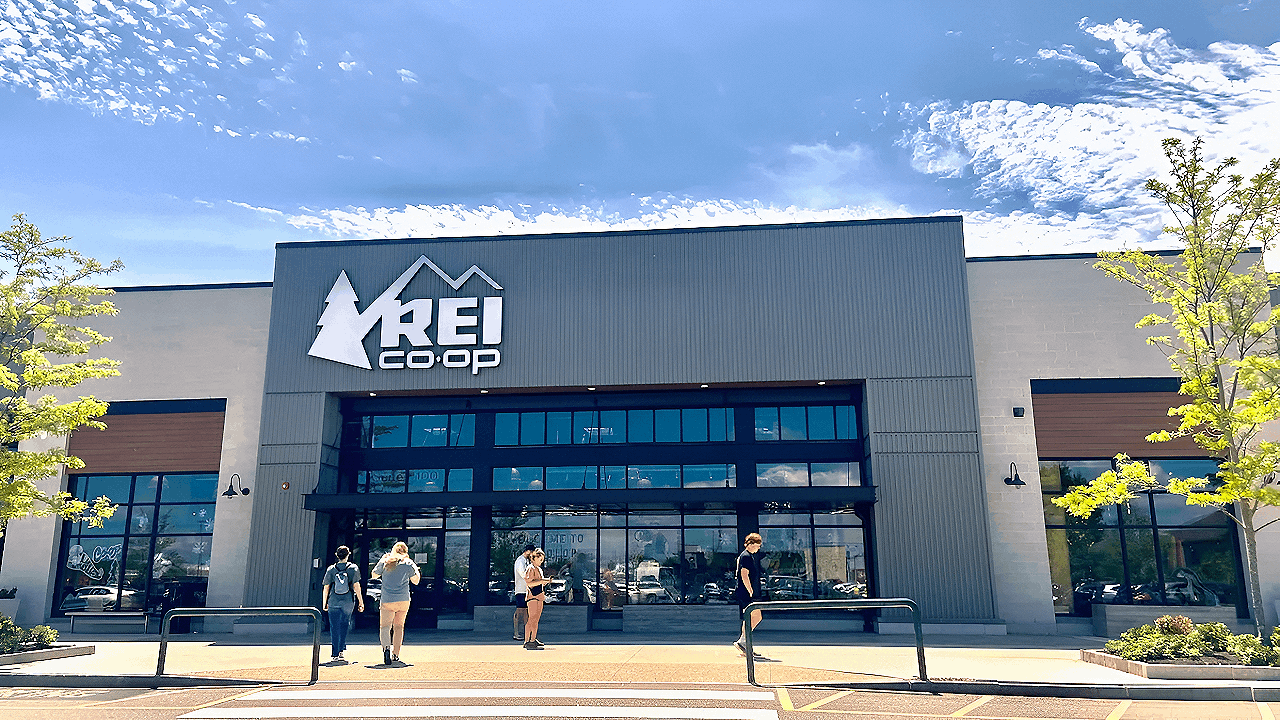
REI Co-op’s Seattle headquarters announced in Oct 2025 that the co-op will close three East Coast stores – its flagship SoHo (Manhattan), plus locations in Boston and Paramus, N.J. – effectively exiting the high-rent NYC market.
The news came as REI confirmed 2024 net sales of $3.53B, down 6.2% from 2023, marking a second straight year of losses.
Deepening Losses
Meanwhile, the co-op’s financial slide accelerated in 2023. REI cut hundreds of jobs in repeated layoff rounds – e.g., 357 positions in January 2024 and another 428 in early 2025.
In 2023 alone, REI lost $311 million, and executives admitted they couldn’t keep absorbing deficits. Artz warned the trend couldn’t continue without dramatic changes.
Flagship Beginnings
To appreciate the significance of the SoHo closure, recall REI’s Manhattan origins. In 2011 REI opened its first NYC store in the historic SoHo Puck Building, a 35,000-square-foot flagship.
Tim Spangler later called it “one of our most extensive restoration projects to date” that blended REI’s 75-year history with the building’s legacy.
Market Headwinds
By early 2024, REI executives were blunt about the tough retail climate. CEO Eric Artz warned employees that while the U.S. economy had avoided a downturn, “outdoor specialty retail has experienced four quarters of decline… and that trend has been worsening”.
The co-op faced an “increasingly challenging and highly promotional” environment, with inventory piling up and discounting eroding margins.
Strategic Pivot
By late September 2025, it all came to a head: new CEO Mary Beth Laughton unveiled “Peak 28: Ascending Together,” a three-year turnaround plan centered on four pillars. She acknowledged REI must make “tough choices” to restore profitability.
Just days later, on Oct. 6, the co-op announced it will shutter the SoHo flagship, Boston, and Paramus stores in 2026.
Manhattan Exit
The loss of SoHo ends REI’s presence in all five NYC boroughs. The 35,000‑sq‑ft SoHo store had been REI’s sole New York City location for 15 years. Its 2026 closure will be the retailer’s first exit from Manhattan since the co-op’s expansion.
Urban outdoor enthusiasts now face losing local gear shops and repair services when the flagship closes.
Employee Backlash

The SoHo announcement sent shockwaves among customers and staff. Longtime REI employees, drawn by its mission-driven culture, expressed dismay. One unionized worker observed that REI must recapture its roots: “That’s what REI has always been, and I feel like we need to get back to that,” said bike-shop veteran Sue Cottrell.
Members and union organizers warned management against undermining the co-op’s values.
Union Milestone

Another major factor is labor: the SoHo store was REI’s first unionized location. On March 2, 2022, workers voted 88–14 in favor of joining the RWDSU/UFCW.
Since then, eleven REI stores nationwide have unionized. Yet as of late 2025, none has reached a new contract, reflecting stalled negotiations and ongoing accusations of union-busting.
Labor Tensions

Unionized employees say relations have grown bitter. Workers filed roughly 80 unfair labor practice charges nationwide, accusing REI of delaying negotiations and rolling back promised raises.
One bike mechanic lamented that leadership had “abandoned the vision of the founders who truly lived REI’s progressive values,” accusing managers of bad-faith bargaining. The NLRB is reviewing the complaints as both sides prepare for contract talks.
Leadership Shakeup

Amid this turmoil, REI’s leadership was overhauled. In Feb 2025, longtime CEO Eric Artz retired, and Mary Beth Laughton (formerly of Nike/Athleta) took the helm. She quickly revamped the executive team: Cameron Janes (an ex-Amazon retail chief) was promoted to COO.
REI has “filled out executive roles with people from Chipotle, Bed Bath & Beyond, and Levi Strauss” since 2022, a marked shift from past decades.
Peak 28 Plan Pillars

Laughton’s Peak 28 strategy rests on four pillars designed to differentiate REI. It aims to foster a “connected, focused and trailblazing culture” and to curate an “authentic, culturally leading” product assortment.
The plan promises gear that is “in stock, priced right, and trend-right”, elevated in-store service, and a reinvented membership program to deepen engagement. Achieving these goals will require fundamental operational changes.
Analyst Concerns

However, many analysts remain skeptical. They note REI’s cost structure is heavy – staffing and occupancy costs consume a high share of revenue – while recent inventory buildups forced steep markdowns.
REI’s merchandise margins have eroded (into the high-30% range by 2023) after years in the mid-40s. Observers question whether the co-op can sustain its high-touch specialty model under such pressure.
Future Footprint

Once the three stores close, REI will operate roughly 192 U.S. locations (down from about 195 today).
The co-op says it will redeploy resources to its most profitable markets. In the coming years, REI must balance wide member access with leaner operations, while navigating ongoing union negotiations and fierce competition in the outdoor retail space.
Cultural Shift
Culturally, workers say REI is at a crossroads. Many joined the co-op for its community-focused mission, and fear that ethos is eroding. “That’s what REI has always been,” one veteran said, lamenting a shift toward cost-cutting over camaraderie.
Employees worry that free classes, environmental advocacy, and the cooperative spirit that set REI apart are giving way to a more conventional retail mindset.
Co-op’s Crossroads
REI is at a crossroads. Leaders insist it can be both profitable and purpose-driven, but the coming years will test that balance. Can the co-op maintain its outdoor-community mission while cutting costs? Or will financial pressures force it to abandon the values that once distinguished REI from typical retailers?
The outcome will determine whether REI remains a unique co-op or becomes another struggling chain.