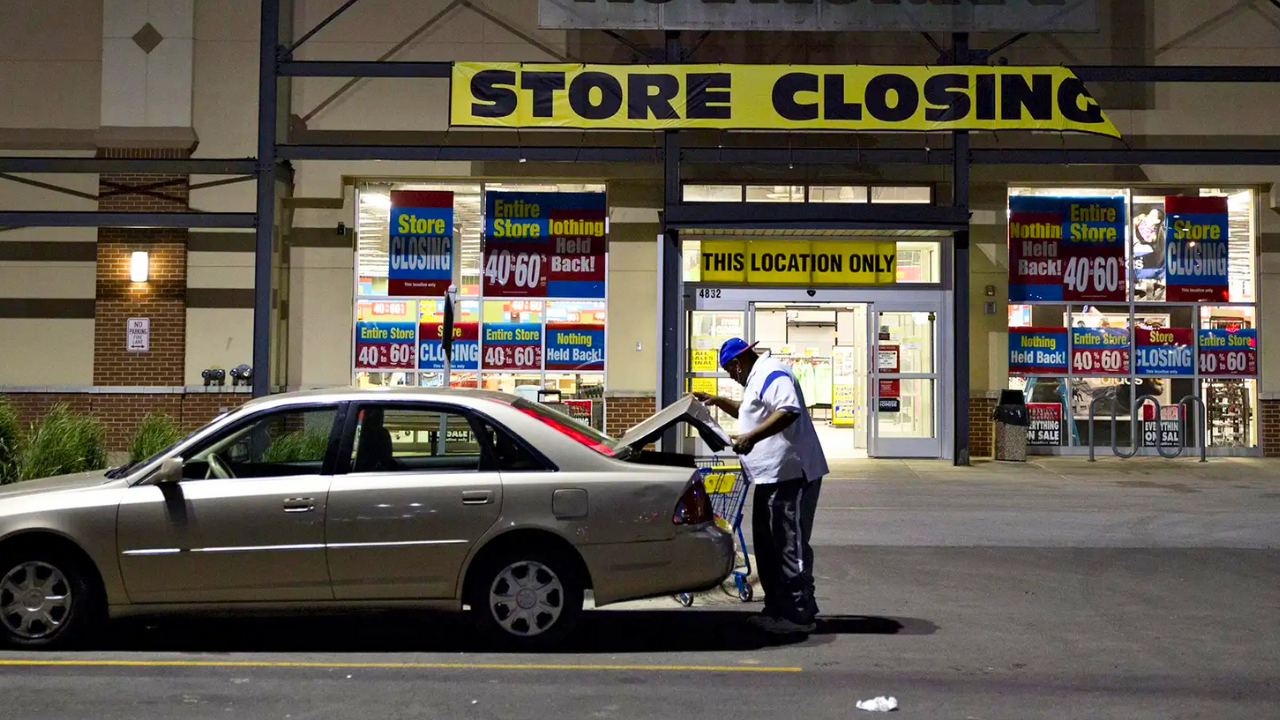
For decades, Supercuts, Cost Cutters, and Roosters were reliable anchors in American malls and strip centers. Operated under the Regis Corporation banner, these salons built one of the largest grooming networks in the country.
But that footprint is now shrinking at historic speed. In 2025 alone, hundreds of storefronts went dark. What once seemed like a stable, “recession-resistant” service business is now caught in a deep, multi-year contraction reshaping everyday retail.
The Shakeout Widens

Retail closures across the U.S. surged in 2025, with more than 3,700 stores already shut or announcing closures. By year’s end, total net closures are projected to approach 9,200 nationwide.
The damage is not limited to struggling independents—major chains that once anchored malls are also retreating. Salon franchises, heavily tied to foot traffic and discretionary spending, are now squarely inside this historic retail shakeout.
A Decade of Decline

Regis’s contraction is not sudden—it has been building for years. More than 100 franchised salons have closed every year since 2020.
The company shut 102 locations in 2020, followed by 273 in 2021, 156 in 2022, and 196 in 2023. By the start of 2025, the Supercuts network had already been dramatically reduced. The latest wave merely accelerates a long-running structural decline.
Franchisee Pressure Mounts

Behind each closure is a franchise owner under mounting financial pressure. Opening a Supercuts franchise requires a total investment of roughly $185,000 to $318,000, including a $39,500 franchise fee.
Once open, owners pay about 6% in royalties and roughly 5% in advertising fees on gross sales. With estimated annual net income between $39,700 and $51,100 for a single store, many operators face thin margins despite significant upfront risk.
The 443 Bombshell
During its Q1 2026 earnings call, Regis confirmed that 443 franchised salons closed during fiscal 2025—the largest single-year contraction in recent company history.
Executives stated that these closures primarily involved underperforming stores with significantly lower sales volumes than top-performing locations. The figure stunned investors and franchisees alike, instantly reframing the scale of the crisis across malls and strip centers nationwide.
Empty Storefronts Across America
Each closure leaves behind a vacant commercial space. In malls, empty salons reduce foot traffic and weaken neighboring businesses. In strip centers, they disrupt tenant balance and depress leasing activity.
With 443 locations shuttered in one year, hundreds of communities now face visible retail gaps where neighborhood salons once operated. These vacancies accumulate quietly but steadily, reshaping the look and function of shopping districts across dozens of states.
Jobs and Livelihoods at Risk

A typical salon employs between 15 and 25 workers. Using that range, the 443 closures in 2025 place roughly 6,600 to 11,000 jobs at risk or already lost.
This mirrors a broader retail labor crisis, as more than 86,000 retail jobs disappeared through September 2025 alone. Salon workers—many living on commission or hourly wages—face sudden income loss with limited economic cushioning.
Competitor Moves and Market Consolidation

As Regis retreats, competitors quietly move in. Independent salons, boutique chains, and larger multi-unit operators are absorbing displaced stylists and capturing underserved markets. The overall salon industry is consolidating toward fewer, better-capitalized operators.
Smaller franchise owners, carrying heavy debt and rising fixed costs, now compete against operators with stronger balance sheets and more flexible leasing arrangements.
Macro Headwinds and Consumer Behavior

Shifting consumer habits are compounding financial stress. Inflation has reduced discretionary spending, while social media and at-home beauty products encourage consumers to stretch time between salon visits. Rising commercial rents further strain mall-based service locations.
These forces converge most aggressively on mid-priced franchises like Supercuts, which depend on consistent, high-volume foot traffic to support slim operating margins.
The Performance Gap

Financial performance differences inside the Regis system are stark. Closed salons averaged roughly $350,000 less in trailing 12-month sales than top-performing locations.
That revenue gap proved decisive. When franchisees fell below profitability thresholds, many could no longer cover rent, labor, and mandatory fees. The widening distance between winning and losing stores transformed the network into a survival contest defined by location quality and consumer density.
Corporate Growth, Franchise Collapse

Ironically, the corporate parent is growing financially even as franchisees disappear. Regis posted $59 million in Q1 2026 revenue, a 28% year-over-year increase. Same-store sales rose a modest 0.9%.
This disconnect—corporate revenue up while hundreds of franchise locations vanish—highlights a structural tension inside the franchise model, where risks are concentrated at the store-owner level while corporate income streams remain comparatively insulated.
The Consolidation Strategy

Executives describe the closures as part of a deliberate strategy to consolidate underperforming units and streamline the network. The company is shifting toward a more asset-light, efficiency-focused franchising model.
By pruning weaker locations, Regis aims to concentrate resources on higher-volume markets. Leadership has stated that 2025 is expected to mark the “last year of closures in this order of magnitude,” signaling a proposed inflection point.
The Loyalty and Digital Pivot

In 2024, Regis launched a loyalty program across approximately 1,900 salons to stabilize repeat traffic. The company is also upgrading digital booking and customer engagement tools to modernize the brand. These efforts aim to increase visit frequency and reduce friction in scheduling.
While early same-store sales growth is modest, management views digital infrastructure as a key pillar of long-term stabilization across the remaining franchise network.
The Franchise Economics Reality

The financial equation for owners is increasingly unforgiving. With total startup costs exceeding $300,000 at the high end, and ongoing fees consuming roughly 11% of gross sales, many franchisees operate with narrow room for error.
Even well-run single-store owners typically net less than $55,000 annually. When sales fall short of projections, losses can accumulate quickly, leaving owners exposed with limited exit options.
Mall-Based Vulnerability
Supercuts built much of its empire inside malls and strip malls—precisely the retail formats now losing traffic fastest. As anchor tenants close, surrounding service businesses lose visibility and walk-in volume.
The structural decline of mall traffic has therefore become an existential threat to salon franchises tied to that infrastructure. The closures reflect not just brand performance but the unraveling of the retail environments that once sustained them.
Economic Ripple Effects

Beyond direct job losses, the closures trigger wider community fallout. Vacant storefronts reduce customer draw for surrounding businesses, lower rental income for property owners, and erode local tax bases. In smaller towns especially, the disappearance of a single chain location can create what economists describe as “retail deserts.”
Over time, these gaps compound into localized economic slowdowns that extend far beyond the grooming industry.
The Franchise Dream Under Pressure

For decades, branded franchises were marketed as a safe path to entrepreneurship. The Regis contraction challenges that narrative. Hundreds of owners paid six-figure sums to access brand recognition, only to face shrinking traffic and rising fixed costs.
The contrast between corporate revenue growth and franchise-level collapse is now reshaping how aspiring entrepreneurs view the true risk profile of service-industry franchising.
Workforce Displacement

Salon workers often build clientele over many years. When a location shuts down, those relationships fracture instantly.
Stylists must relocate to new shops, rebuild customer bases, or exit the profession entirely. Because many are paid through a mix of hourly wages and commissions, income volatility is extreme after closure. The human cost of consolidation is therefore borne most heavily by workers with the least financial cushion.
The Tipping Point Narrative

Regis leadership now frames 2025 as a turning point rather than a collapse phase. Executives argue that aggressive pruning of underperforming units will produce a smaller but healthier network. Whether this proves accurate remains uncertain.
The historical trend shows closures exceeding 100 locations every year since 2020. For franchisees still operating, the promise of stabilization now competes with years of lived contraction.
What This Really Signals
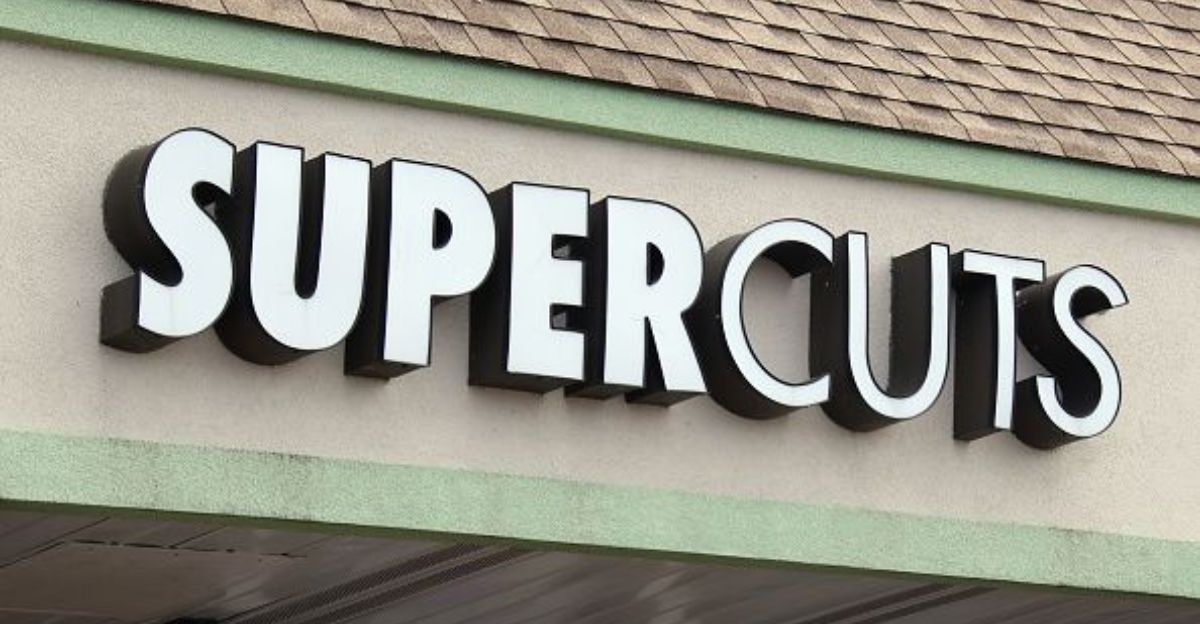
The 443 Supercuts closures represent more than a corporate restructuring—they reflect a structural shift in American retail and franchising. Mall-based service businesses are losing economic viability. Franchise ownership no longer guarantees stability.
Even essential services like haircuts are being reshaped by foot-traffic decline, digital disruption, and margin compression. The contraction at Regis stands as a visible warning: the old retail playbook is breaking down, one emptied storefront at a time.
Sources:
- Regis Corporation – Q1 2026 Earnings Call Transcript – November 2025
- Business Wire – Regis Corporation Reports Financial Results for Fourth Fiscal Quarter and Full Fiscal Year 2025
- Frezka SaaS – Top Reasons Why Salon Businesses Fail (And What You Can Do Differently to Thrive in 2025)
- Business Wire – Regis Corporation Reports Financial Results for the First Fiscal Quarter 2026 – November 12, 2025
- TradingView – REGIS CORP SEC 10-Q Report – 2025 –
- TipRanks – Regis Corporation’s Earnings Call Highlights Growth and Challenges